
Is Your Moldavite Real? Six Things Experts Check Before They Say Yes

QUICK ANSWER BOX
Want to know if your Moldavite is genuine? Start by checking its natural surface texture, internal bubbles, color, and exact origin. Real Moldavite was forged in a meteorite strike millions of years ago, giving it a wildly different internal structure than cheap factory glass. Knowing these specific quirks is your absolute best defense against getting scammed by a clever fake Moldavite.
INTRODUCTION
Shopping for authentic Moldavite these days is tricky. You jump online, and suddenly half a dozen perfectly green, glassy stones are staring back at you—all claiming to be the real deal. As this rare green tektite absolutely explodes in popularity, the fake market has boomed right alongside it.
This isn't your average gemstone. It didn’t grow slowly in the Earth's crust. It was born from chaos specifically, a massive meteorite slamming into southern Germany near the Ries Crater. The heat was so intense it melted the earth, flung it into the sky, and rained it down over the Czech Republic. That violent birth gave Moldavite physical quirks you just can't fake in a lab.
If you're tired of second-guessing your purchases, you're in the right place. We're going to break down exactly what veteran collectors and gem experts look for. You'll learn which red flags to watch out for, the myths you need to ignore, and why the stone's backstory is your best friend.
Who This Is For: New collectors, experienced enthusiasts, jewelry buyers, geology enthusiasts, and anyone researching authentic Czech Moldavite.
Why Authentic Moldavite Is Often Misidentified
People are Googling how to identify real Moldavite more than ever, and for good reason: fakes are getting alarmingly good. We are way past the days of obvious, cheap bottle glass. Today's counterfeiters have figured out how to mimic the color and even some of the irregular shapes that make this stone famous. But here's the catch: they cannot replicate nature perfectly.
Because true Moldavite is impact glass, its entire makeup is tied to that one catastrophic event. You can't just mine more of it. It's almost entirely locked to specific Czech regions.
The biggest trap I see beginners fall into? Buying with their eyes alone. A stone looks pretty, it's the right shade of green, so they hit "Add to Cart." But a nice color proves absolutely nothing. If you want to spot a fake, you have to understand how the real thing was actually made.
Six Expert Checks Professionals Use Before Saying "Yes"
Spotting a genuine tektite isn't about one magic test. Professional collectors examine the whole specimen. Here is exactly what they look for:
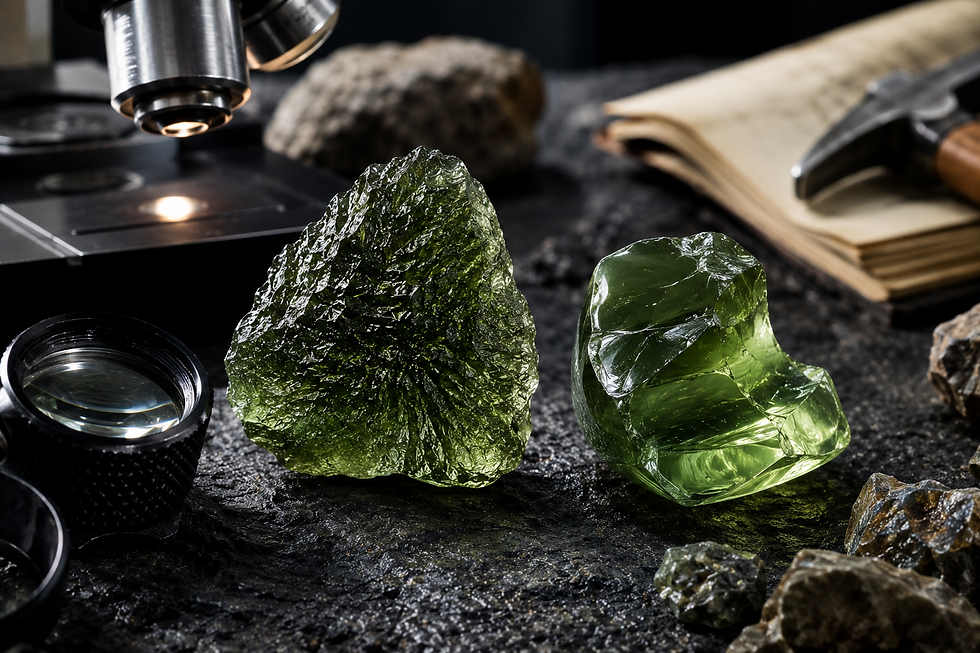
Examine the Natural Surface Texture: Look at the surface. Real Moldavite has been sitting in Czech dirt for millions of years. It's deeply etched, scarred, and wildly uneven. Factory fakes try to copy this, but they usually end up looking too smooth, overly glossy, or artificially stamped.
Look for Internal Flow Structures and Tiny Bubbles: Grab a magnifying glass and look inside. Real impact glass cooled incredibly fast in mid-air. That chaotic cooling trapped tiny, stretched-out bubbles and weird, elongated flow lines (called lechatelierite). See perfectly round bubbles? That’s a massive red flag. Factory glass has round bubbles; meteorite glass doesn't.
Evaluate the Color Carefully: Authentic pieces hover somewhere between olive to deep forest green. Sure, thinner spots might look lighter. But if a seller is pushing a stone that looks like a neon-green traffic light, walk away.
Consider the Overall Shape: Mother Nature doesn't do perfect symmetry. Natural tektites are weirdly shaped, with unpredictable ridges and folds. If a piece looks like it was carefully sculpted or polished to look "aesthetic," be highly suspicious.
Ask About Provenance: Never buy without asking: "Where exactly did this come from?" Genuine stones have paperwork or clear histories tying them to known Czech localities—think Besednice, Chlum, or Slavče. A seller who says, "I don't know, my supplier sent it," isn't someone you want to buy from.
Evaluate the Seller's Knowledge: Good dealers love talking geology. They want to educate you on the stone’s history and preservation. Educational platforms—like what we do at Rare Moldavites—hammer this point home: buy the geology, not the hype. If a seller relies purely on marketing buzzwords and dodges questions about origin, take your money elsewhere.
Common Mistakes Buyers Make When Checking Moldavite
It's easy to get tunnel vision when you're hunting for a specific piece. Avoid these common rookie mistakes:
Expecting uniformity: It's natural glass. Variations in thickness, transparency, and texture are completely normal. A perfectly uniform appearance is usually a bad sign.
Relying on the "Moldavite flush": Yes, people claim the stone makes them dizzy or hot. But a physical reaction isn't a lab test. Fakes won't become real just because you felt a tingle. Base your purchase on geology, not vibes.
Trusting online photos blindly: Photos lie. A dark stone can look emerald-bright under a harsh ring light. Always ask the seller for unedited photos taken in varied lighting.
Judging purely by price: Scammers know you associate high prices with authenticity. They will happily overcharge you for green glass just to trick you. Value depends on locality, condition, and rarity—not just the price tag.
Real vs Fake Moldavite: What Experts Notice First
When you put a real piece next to a fake, the differences usually come down to how chaotic the internal structure looks.
Feature | Authentic Moldavite | Fake/Manufactured Glass |
Surface Texture | Deeply scarred, organic, random etching | Too smooth, glossy, or repetitive "stamped" patterns |
Internal Bubbles | Elongated, stretched, and irregular | Perfectly spherical, or missing entirely |
Coloration | Earthy olive to forest green | Unnatural neon, or perfectly uniform color |
Internal Flow | Visible, chaotic flow lines | Clear, uniform glass with no natural flow |
Weight / Density | Feels surprisingly light for its size | Often feels heavy/dense like a beer bottle |
Why Provenance Matters More Than Most People Realize
Why does the backstory matter so much? Because this stuff isn't being made anymore. Knowing exactly where a piece was dug up adds an incredible layer of security. Since high-quality, newly unearthed pieces are drying up, the chain of custody means everything. Documentation showing where a piece was found or how long it's been in a private collection strengthens long-term confidence.
At Rare Moldavites, we focus heavily on this. If you don't know the exact Czech locality your stone came from, you're just gambling. Education and provenance should always support your purchase.
Frequently Asked Questions
How can I identify real Moldavite at home?
Get a jeweler's loupe and look inside the stone. You are hunting for elongated, weirdly shaped bubbles and chaotic flow lines. Combine that internal check with the exterior—it should look deeply etched and natural, not glossy and smooth. Don't rely on just one feature; check the whole stone.
Is Moldavite real if I feel the "Moldavite flush"?
Nope. While it's a popular community belief that genuine stones cause warmth or tingling, it doesn't prove a thing scientifically. You have to identify the stone through its physical, geological traits.
What is the easiest way to spot fake Moldavite?
The texture and the bubbles are usually dead giveaways. Fakes often look "wet," overly shiny, or have perfectly smooth edges. If you look closely and see perfectly round, symmetrical bubbles inside the glass, it's a confirmed fake.
Why is authentic Moldavite becoming more difficult to find?
It's a finite resource. It only formed once, during a single cosmic event millions of years ago. As global demand skyrockets, the supply of high-quality specimens in the ground is dropping, pushing more pieces into permanent private collections.
What should I ask before buying Moldavite?
Always ask: "What specific Czech locality is this from?" A good seller will name the exact region, provide high-quality, unedited photos, and happily discuss the piece's natural characteristics.
CONCLUSION
Learning how to spot the real deal takes a bit of patience and a good magnifying glass. While the fakes out there are getting better, they still can't perfectly replicate a cosmic impact. By looking closely at the surface scars, the stretched internal bubbles, and demanding clear provenance, you can easily separate the genuine tektites from the cheap glass.
Education is your best tool. Keep studying verified examples, ask sellers the hard questions, and build your knowledge before adding a piece of this geological history to your collection.


Comments